
DC to Florida Moving: The Complete 2026 Guide
A move from the Washington DC area to Florida covers roughly 1,000 to 1,100 miles and typically takes three to five business days in transit. For a two- to three-bedroom home, expect somewhere between $4,000 and $8,000 depending on distance, volume, and services. Here is how the corridor actually works.
What’s in this guide
- How far is it, and how long does the move really take?
- What a DC-to-Florida move costs in 2026
- Why warehouses at both ends change the timeline
- What moving day actually looks like
- Where DC transplants are landing in South Florida
- Your eight-week countdown
How far is it, and how long does the move take?
The drive from Metro DC to South Florida is about 1,050 miles to Fort Lauderdale and roughly 1,075 to Miami — call it sixteen to eighteen hours of pure driving. But your furniture does not travel the way you do.
Federal hours-of-service rules cap a commercial driver at eleven hours of driving within a fourteen-hour window, followed by ten consecutive hours off duty. That alone stretches a one-day car trip into a two-day truck trip. Add loading, fuel stops, and the delivery window at the far end, and a realistic transit time for a DC-to-Florida move is three to five business days from the day your shipment leaves.
What varies is not the driving. It is everything around it. On a traditional interstate move, your shipment shares a trailer with several other households. The truck cannot deliver to you until it has worked through the other stops in a sensible order, which is why so many movers quote a delivery spread — a window of seven, ten, sometimes fourteen days rather than a date. You are not waiting on the road. You are waiting on the routing.
That distinction matters more than almost anything else you will read about long-distance moving, and it is the reason the next section is about warehouses rather than trucks.
What a DC-to-Florida move costs in 2026
Interstate moves are priced on weight and distance, then adjusted for services. As a working range for the DC-to-Florida corridor:
| Home size | Typical weight | Estimated range |
|---|---|---|
| Studio / 1 bedroom | 2,000–3,500 lbs | $2,400–$4,200 |
| 2 bedrooms | 4,000–5,500 lbs | $4,000–$6,200 |
| 3 bedrooms | 6,000–8,000 lbs | $5,400–$8,000 |
| 4+ bedrooms | 9,000–12,000+ lbs | $7,500–$12,000 |
These are planning figures, not quotes. Four things move a number inside — or outside — that range:
- Packing. Full-service packing is usually the single largest add-on. It also shifts liability: when a professional crew packs a box, the mover is responsible for what is inside it. When you pack it yourself, you generally are.
- Access at both ends. A long carry from truck to door, a shuttle because a tractor-trailer cannot reach the property, stairs, or an elevator reservation in a managed building all add labor hours.
- Timing. Late May through early September is peak season nationally, and the last and first few days of any month are the busiest. Moving mid-month, mid-week, in October or February will almost always cost less than the same move on the last Friday in July.
- Storage in the middle. Common on this corridor, and covered below.
On very low quotes. If one estimate comes in dramatically under the others, find out whether it is binding. A non-binding estimate can be revised upward after your shipment is weighed — sometimes after it is already on the truck. Ask for the estimate type in writing, and ask what happens if the actual weight exceeds the estimate.
Why warehouses at both ends change the timeline
Most movers handling the DC-to-Florida route are working one end of it. The shipment leaves their territory and enters someone else’s — a partner agent, a hired crew, occasionally a driver operating independently. That handoff is where delivery windows widen and accountability gets fuzzy.
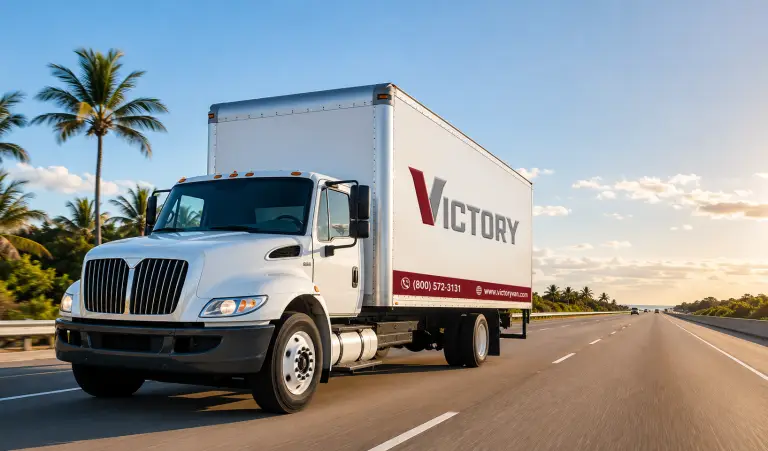
VICTORY operates warehouses at both ends of this corridor: Sterling, Virginia, in Metro DC, and Deerfield Beach, Florida, in Broward County. We run the route weekly with our own assets on both sides. Three practical consequences follow:
The delivery window narrows. When the origin and destination are both yours, scheduling is a planning problem rather than a negotiation with a third party. You get a date range measured in days, not weeks.
Storage becomes easy instead of complicated. This is the one most people underestimate. Closing dates rarely line up. Florida construction and renovation timelines slip. New-build handovers move. If your Florida home is not ready, your shipment goes into our warehouse — at either end — and comes out when you are. There is no scramble to find a third-party storage facility in a market you do not know, and no second company handling your furniture. See storage options for how that works.
One accountability chain. If something needs sorting out, the coordinator who booked your move can see where your shipment is and who has it. That sounds obvious. On a 1,000-mile interstate move split between companies, it frequently is not.
What moving day actually looks like
Here is the sequence, start to finish.
Before you book: the estimate
Long-distance estimates should be based on a survey, not a phone guess. A virtual estimate takes about twenty minutes on your phone — you walk a coordinator through each room on video, including closets, the garage, the basement, and the attic, because those are where the weight hides. You get a written estimate that reflects what you actually own.
Two to three weeks out: the plan
A move coordinator is assigned and stays with you through delivery. This is when packing services are confirmed, valuation coverage is chosen, and building requirements are handled — elevator reservations, loading dock windows, and the certificate of insurance many managed buildings and Florida HOA communities require before a truck is allowed on site.
Load day
The crew arrives with an inventory sheet. Every item is tagged and condition-noted before it goes on the truck. You sign the inventory. Keep your copy — it is the document that matters if anything needs to be claimed later. Plan for a full day for a three-bedroom home, more if the crew is also packing.
Transit
Three to five business days on this route. Your coordinator confirms the delivery window while the shipment is moving.
Delivery day
The crew unloads, checks each tagged item against the inventory, places furniture in the rooms you designate, and reassembles anything that was taken apart. Standard service includes one placement per item — deciding where the sofa goes before the truck arrives saves everyone an hour.
Where DC transplants are landing in South Florida
Patterns show up when you run the same corridor every week. Four areas come up repeatedly for households moving down from Metro DC.
Boca Raton. The most common landing spot for households moving from Northern Virginia and Montgomery County. Strong schools, a substantial corporate presence along the I-95 corridor, and a mix of gated communities and walkable downtown living. It is also the most expensive of the four.
Deerfield Beach. Immediately south of Boca and noticeably more affordable, with a genuine beach town character. Our Florida warehouse is here, which means short final-mile delivery for anyone landing in the area. Popular with buyers who want proximity to Boca without Boca pricing.
Fort Lauderdale. The urban option — the closest thing in South Florida to city living, with a growing tech and finance base, a major international airport, and neighborhoods ranging from Las Olas high-rises to single-family Victoria Park. Note that many downtown buildings have strict move-in rules; expect to reserve a freight elevator.
Coral Springs. Inland, master-planned, quieter, and the most family-oriented of the four. Larger lots for the money, well-regarded schools, and a longer drive to the beach. Households moving for space rather than water tend to end up here.
More detail on the region is on our South Florida locations page.
Your eight-week countdown
Eight weeks out. Book the estimate. Peak-season dates go early, and the last week of any month fills first. Start a document folder — lease or closing paperwork, school records, vet records, HOA move-in packets.
Six weeks out. Book the mover. Decide packing: full, partial, or self. If your Florida closing date is not locked, tell your coordinator now so storage is built into the plan rather than bolted on later.
Four weeks out. Start disposing of what is not going. Long-distance moves are priced by weight, so this is one of the few points where decluttering has a direct dollar return. Request the certificate of insurance from your mover if either building requires one — it takes one to three business days, and it is a common cause of a cancelled move day.
Three weeks out. File the USPS change of address. Notify banks, insurers, and subscription services. Arrange transfer of medical and school records. Schedule utility shutoff at origin and activation at destination, with the destination live the day before delivery.
Two weeks out. Confirm elevator reservations and dock windows. Service anything that needs it before transport. Plan pet and plant transport separately — movers cannot carry either, and Florida has agricultural restrictions on some plants.
One week out. Pack an essentials box you keep with you: medications, chargers, documents, a change of clothes for each person, basic tools, toiletries, coffee. Confirm the load window in writing. Empty and defrost the refrigerator at least 24 hours ahead.
Load day. Walk the house with the crew chief before they start and again before they leave. Check every closet, cabinet, and the attic. Keep your signed inventory.
Ready to make the move? VICTORY runs the DC-to-Florida corridor every week with our own trucks and warehouses at both ends — Sterling, Virginia and Deerfield Beach, Florida. A coordinator stays with your move from estimate through delivery.
Frequently asked questions
How long does a DC to Florida move take?
Three to five business days in transit for most households. The drive itself is sixteen to eighteen hours, but federal hours-of-service rules limit drivers to eleven hours behind the wheel in a fourteen-hour window, and the delivery window at the destination depends on how the shipment is routed. Movers running the corridor on a fixed weekly schedule can generally commit to a narrower window than those consolidating loads across many destinations.
What is the cheapest way to move from DC to Florida?
Renting a truck and driving it yourself is the lowest sticker price, but the real comparison includes fuel for roughly 1,050 miles, two nights of lodging, equipment rental, and the labor of loading and unloading a house twice. For a one-bedroom apartment it can genuinely be the cheaper option. From two bedrooms up, the gap narrows quickly. If you want to reduce the cost of a professional move: book outside peak season, avoid the last and first few days of the month, pack yourself, and shed weight before the estimate rather than after.
Does VICTORY move from Florida back to DC?
Yes. The corridor runs both directions weekly, with the same warehouses and the same crews at both ends. Northbound moves — including snowbirds returning seasonally and households relocating back for work — are a routine part of the schedule.
Can I store items at one end while I prepare my new home?
Yes, and on this route it is common. Closing dates slip and Florida construction timelines move. Your shipment can be held in our Sterling, Virginia warehouse or our Deerfield Beach, Florida warehouse and released when your home is ready — no third-party storage company, no additional handling by a company you have not met. Tell your coordinator early so it is priced into the plan.
How much should I tip movers on a long-distance move?
Tipping is entirely optional. Where customers do tip on long-distance moves, a common approach is $20 to $50 per crew member at load and again at delivery, adjusted for the size of the job, stairs, long carries, and how the crew handled the day. On an interstate move the loading and delivery crews are often different people, so budget for both.
This content is for informational purposes. Cost ranges are planning estimates based on typical shipments and are not quotes. Your estimate will reflect your actual inventory, distance, services, and dates.