
How to Pack a Kitchen for a Move: A Room-by-Room Guide
Pack a kitchen over two to three days, not one. Start with what you rarely use — small appliances, serving pieces, the back of the pantry — and finish with an essentials box you keep out until the last morning. Wrap every dish individually, stand plates on edge, and never stack more than five to a layer.
What’s in this guide
- Why the kitchen takes longer than you think
- What to pack first
- What to pack last: the essentials box
- How to pack dishes and glassware properly
- Appliances, large and small
- What movers cannot take
- When to hand the kitchen to a crew
Why the kitchen takes longer than you think
Ask any move coordinator which room runs behind on packing day and the answer is the kitchen, every time. A bedroom is mostly soft goods in large containers. A kitchen is several hundred individual objects, most of them fragile, many of them oddly shaped, and nearly all of them stored in a way that made sense for cooking and makes no sense at all for a box.
Budget two to three days for a full kitchen. A galley kitchen in an apartment might take an afternoon. A family kitchen with a pantry, an island, and a china cabinet will take longer than that, and will consume more boxes and more paper than any other room in the house.
One number worth knowing before you start: a properly packed kitchen for a three-bedroom home usually runs 15 to 25 boxes and about 10 pounds of packing paper. Buy more paper than you think you need. Running out mid-cabinet is how people start improvising with towels and newspaper, and both cause problems — towels do not cushion the way paper does, and newsprint transfers ink onto everything it touches.
What to pack first
Work backwards from how often you actually use something. Two to three weeks out, box up:
- Small appliances you use occasionally — stand mixer, food processor, bread maker, waffle iron, the second blender
- Serving pieces and entertaining ware — platters, punch bowls, the good china, holiday dishes
- Specialty cookware — roasting pans, stockpots, the cast iron you use twice a year
- Decorative items — anything on top of the cabinets, cookbooks, wall pieces
- The back of the pantry — sealed, shelf-stable goods you are keeping
Label every box on two sides, not the top. Once boxes are stacked in a truck or a room, the tops are invisible. Write the room and a short contents line: “Kitchen — stand mixer, mixing bowls.” Mark fragile boxes clearly on all four sides.
What to pack last: the essentials box
Set aside one box — or better, a clear plastic bin you can see into — that stays with you rather than going on the truck. For most households that means:
- Coffee maker, filters, coffee. This is not a joke; it is the single most requested item on the morning after a move.
- One pot, one pan
- Plates, bowls, and cutlery for each person
- A sharp knife, a cutting board, a can opener, a corkscrew
- Dish soap, a sponge, paper towels, trash bags
- Salt, pepper, oil
Everything in the kitchen you use daily gets packed on the final morning, into the last box loaded onto the truck. That way it comes off first.
How to pack dishes and glassware properly
This is where most breakage happens, and nearly all of it is avoidable.
Use dish barrels or cell boxes. A dish barrel is a double-walled box built for exactly this. Cell dividers turn a box into individual compartments for stemware. Standard moving boxes are fine for pots; they are not the right container for a set of plates.
Cushion the bottom. Two to three inches of crumpled paper before anything goes in. Do the same at the top before closing.
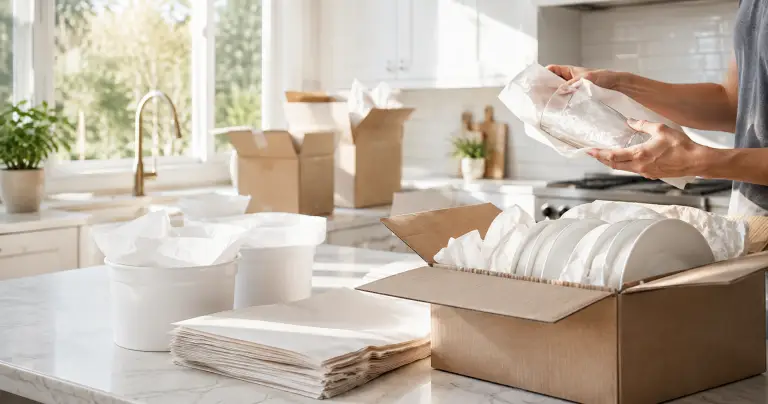
Wrap every piece individually. Lay a sheet of paper flat, place the item at one corner, roll, tuck the sides in as you go. It is slower than wrapping in batches and it is the difference between a box that arrives intact and one that does not.
Stand plates on edge, like records. A plate lying flat takes the full weight of everything above it across its widest, weakest plane. On edge, it takes load through its strongest axis. This one change prevents more breakage than any other. Five to a layer, maximum.
Heaviest at the bottom, lightest at the top. Plates and bowls low, glassware and cups high.
Fill every void. Shake the box gently before taping. If anything shifts, add paper. Movement inside a box in transit is what breaks things — not the drop you are imagining.
Stemware gets extra care. Wrap the bowl and the stem separately, then wrap the whole glass again. Stems always go upright in a celled box, never on their side.
Weight limit. Keep any single box under about 50 pounds. It is easy to exceed that with dishes without noticing, and an overloaded box fails at the bottom seam — usually while someone is carrying it down stairs.
Appliances, large and small
Refrigerator. Empty it, then defrost and dry it at least 24 hours before load day. A freezer that is still thawing will leak in the truck and can leave mould in a sealed unit. Tape the doors closed only for transit, and prop them open once it is in place at the destination.
Dishwasher, washer, and gas ranges. These need to be disconnected before the crew arrives. Water lines, gas lines, and hardwired connections are usually outside the scope of a moving crew and often require a licensed trade. Arrange it a week ahead — this is one of the most common reasons a load runs late.
Stand mixers and food processors. Remove the bowl, the blade, and any attachment, wrap each separately, and pack the motor base upright with cushioning on all sides. Blender and processor blades should be wrapped in paper and taped closed so nobody reaches into a box and finds one edge-first.
Small appliances generally. Original boxes are ideal if you kept them. If not, wrap the body, wrap the cord separately and tape it to the body so it does not whip around inside the box.
What movers cannot take
Federal regulations prohibit moving companies from transporting hazardous materials, and several kitchen staples qualify. Plan to use, give away, or dispose of:
- Open food and anything perishable
- Aerosols, including non-stick cooking spray
- Charcoal, lighter fluid, propane canisters for portable grills
- Household cleaners containing bleach or ammonia
- Open liquids of any kind, including wine and oil that has been opened
Sealed, shelf-stable pantry goods are generally fine on a local move. On a long-distance move, where the shipment may sit in a warm trailer for several days, most coordinators will advise against it — heat ruins more pantry goods than people expect.
When to hand the kitchen to a crew
Professional packing is worth considering for the kitchen specifically, even if you pack the rest of the house yourself. Two reasons.
The first is speed. A two-person crew will pack a family kitchen in three to four hours — work that takes most households two to three evenings.
The second matters more. When a professional crew packs a box, the mover is responsible for what is inside it. When you pack it yourself, coverage for the contents is generally limited, because nobody can verify how it was packed. For a cabinet of inherited china or a full set of stemware, that shift in liability is often the whole argument.
You can also split it: crew packs the kitchen and anything fragile, you handle the bedrooms and the closets. Ask for a partial packing quote when you book — most people do not realise it is an option, and it appears on every residential moving estimate we write.
One last note on timing. On a local move, a poorly packed kitchen costs you an hour of crew time. On a long-distance move it costs you breakage, because the shipment is handled more times and travels for days. The further you are going, the more the packing decision matters.
Want the kitchen handled? VICTORY offers full and partial packing across Metro DC and South Florida — including fragile-only service for kitchens and china. Tell us what you want to keep and what you want to hand over.
Get a free virtual estimateFrequently asked questions
How early should I start packing the kitchen before a move?
Begin two to three weeks out with rarely used items, and expect the room to take two to three working days in total. Leave daily-use items for the final morning. Starting the kitchen the night before is the most common packing mistake, and it is the reason move days run late.
Can movers pack my kitchen for me?
Yes. Most moving companies offer full packing, partial packing, or fragile-only service. The kitchen is the most frequently requested partial-pack room. A two-person crew typically completes a family kitchen in three to four hours, and because they packed the boxes, the mover carries responsibility for the contents.
How do I pack wine glasses without breaking them?
Use a cell box with dividers. Wrap the bowl and the stem separately, then wrap the whole glass a second time. Stand each glass upright in its own cell — never on its side. Cushion the bottom of the box with two to three inches of crumpled paper and fill any gap at the top before taping.
What supplies do I need to pack a kitchen?
For a three-bedroom home: 15 to 25 boxes including two to four dish barrels, at least one celled box for stemware, roughly 10 pounds of unprinted packing paper, bubble wrap for anything irregular, packing tape, and a marker. Buy more paper than you estimate — running short mid-cabinet is when improvised materials start causing damage.
This content is for informational purposes. Restrictions on non-allowable items follow federal regulations and may vary by shipment type — your coordinator can confirm what applies to your move.