
What Is an Allied Van Lines Agent — and Why Does It Matter for Your Move?
An Allied Van Lines agent is an independent local moving company that operates within the Allied network — not a branch office and not an employee of Allied. The agent owns your move end to end, uses the van line’s national infrastructure to move your shipment across state lines, and remains accountable for it the whole way.
What’s in this guide
- What a van line actually is
- Agent vs. van line: who is doing the work?
- How an interstate move travels through the network
- Agent vs. broker — the distinction that matters most
- What “Certified ProMover” means in 2026
- Why network scale changes your experience
What a van line actually is
Allied Van Lines is one of the largest van lines in the United States, founded in 1928 and operating today across all fifty states and more than 130 countries. But a van line is not a single company with trucks in every city. It is a network — a national carrier authority, a shared logistics infrastructure, and a set of standards, joined to hundreds of independent local moving companies that have been vetted and credentialed to operate under it. Those local companies are the agents. They own the warehouses. They employ the crews. They are the ones who show up at your door.Agent vs. van line: who is doing the work?
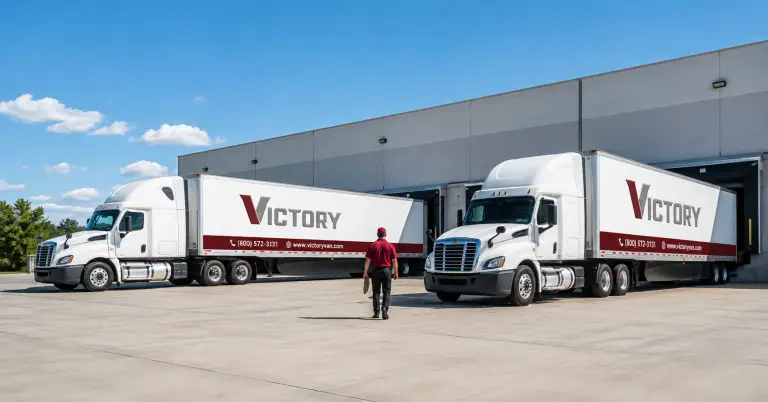
This is the part almost nobody explains, and it changes how you should read every quote you receive. When you book an Allied move, you are contracting with a local agent — a real company with a physical address, its own employees, its own equipment, and its own reputation in your market. That agent handles your survey, your estimate, your packing, your loading, and your coordination. What the van line provides is the layer the agent could not build alone: interstate operating authority, a national linehaul network so a shipment leaving Virginia can reach Oregon, long-haul drivers, claims infrastructure, tracking systems, and a common standard every agent in the network is held to. The practical version: you get a local company that knows your building, your county, and your traffic, backed by national infrastructure it did not have to invent. VICTORY has been that local company in Metro DC since 1928, when it was founded as the Federal Storage Company. It took the Victory Van name in 1945. Today it is Allied’s largest agent in the Mid-Atlantic, and it has been employee-owned since 2008 — meaning the crew loading your truck are owners of the company, not contractors hired for the day.How an interstate move travels through the network
Say you are moving from Arlington, Virginia to Denver. The sequence looks like this:- The origin agent surveys, estimates, packs, and loads. This is your primary relationship and your point of accountability.
- Linehaul carries the shipment across the country — an Allied driver, on Allied’s operating authority, with your inventory documented under a single bill of lading.
- The destination agent — another credentialed member of the same network — unloads and places, working from the same paperwork.
- Your origin coordinator stays with the move throughout. If something needs resolving in Denver, you do not start over with a company you have never spoken to.
Agent vs. broker — the distinction that matters most
If you take one thing from this article, take this. A broker does not move anything. A broker sells your job to a carrier — often one you have not researched, sometimes one selected on price after you have already paid a deposit. Brokers are legally required to be registered with the Federal Motor Carrier Safety Administration and to disclose that they are brokers, but the disclosure is frequently buried, and many people do not realise the company they spoke to will never touch their belongings. An agent is a carrier. It performs the move with its own people and equipment, and it is accountable for the outcome. Here is how to tell the difference before you sign:| Check | Agent / carrier | Broker |
|---|---|---|
| USDOT number | Registered as a carrier | Registered as a broker |
| Physical location | Warehouse and offices you can visit | Often a call centre only |
| Who surveys your home | Their own estimator, in person or on video | Frequently no survey at all |
| Who arrives on move day | Their employees | Unknown until shortly before |
| Large upfront deposit | Uncommon | Common |
The tell to watch for. A quote given over the phone, sight unseen, with a large deposit required to hold the date. Reputable carriers survey before they price, because they cannot know what they are moving until they have looked at it.
What “Certified ProMover” means in 2026
ProMover is the moving industry’s principal certification programme. Companies that carry it have been vetted for federal registration and operating authority, agreed to a published code of conduct covering estimating and advertising practices, and undergone a background review. One point of accuracy, because a great deal of outdated information circulates on this: ProMover was created by the American Moving & Storage Association. AMSA was absorbed into the American Trucking Associations in December 2020, and the programme is now administered by the ATA Moving & Storage Conference. If a mover’s website still describes AMSA as a current, separately operating organisation, its credential page has not been updated in some years — a small thing, but a reasonable signal about how closely a company maintains its own compliance information. ProMover is not a guarantee of a good move. It is a floor, not a ceiling. But it filters out a meaningful share of the operators responsible for the industry’s worst outcomes, and it costs you nothing to check.Why network scale changes your experience
Scale within a van line network is not a vanity statistic. It affects three things you will actually notice. Equipment availability. A larger agent has more trucks, more crews, and more warehouse space, which means fewer date conflicts in peak season and more room to absorb a schedule change when your closing slips. Crew depth. Specialised work — data centre relocations, hotel FF&E, library collections, high-value art — requires crews who have done it before. Volume is what makes it possible to keep those teams employed year-round rather than assembling them per job. Leverage inside the network. When a shipment needs attention at the far end, an agent moving significant volume gets a faster answer than one moving very little. It is not a formal rule. It is simply how relationships work. None of this means a large agent is automatically better than a small one. Plenty of small agents run outstanding operations. But when you are comparing companies and both are credentialed carriers within the same network, scale is a legitimate tiebreaker — and it is worth asking about directly.
Planning an interstate move? VICTORY is Allied Van Lines’ largest agent in the Mid-Atlantic, employee-owned since 2008, with warehouses in Sterling, Virginia and Deerfield Beach, Florida. One coordinator, one accountability chain, start to finish.
Get a free estimate
Frequently asked questions
Is Allied Van Lines a good moving company?
Allied is one of the largest and longest-established van lines in the United States, operating since 1928. But your experience depends far more on the local agent performing the move than on the van line brand. Two agents in the same network can deliver very different service. Research the specific agent quoting you — check the USDOT registration, read reviews tied to that company’s name and location, and confirm they will use their own crews.What is the difference between a van line and a moving company?
A van line is a national network providing interstate operating authority, linehaul transportation, and shared standards. A moving company — the agent — is the independent local business that surveys, packs, loads, and coordinates your move. You hire the agent. The van line is the infrastructure the agent uses to move your belongings across state lines.How do I know if my mover is reputable?
Verify the USDOT number on the FMCSA’s public database and confirm the authority type is carrier rather than broker. Check that the company has a physical warehouse address you could visit. Insist on a survey — in person or by video — before accepting an estimate. Be cautious of large upfront deposits and quotes given without any survey. Look for ProMover certification, and read reviews attached to that specific location.Does VICTORY use subcontractors?
VICTORY performs moves with its own employee crews and equipment. On interstate moves, the delivery portion in a distant market may be handled by another credentialed agent within the Allied network — this is how every van line reaches every state — but the shipment travels under one bill of lading, and your VICTORY coordinator remains your point of contact from estimate through delivery.This content is for informational purposes. Certification and registration details are current as of publication; verify a mover’s status directly with the FMCSA before booking.